

In a traditional call center, hardware and strict office demands are costly and demanding. A local power outage or a sudden storm can instantly freeze customer support in the area.
A virtual contact center shifts work to the cloud. Hence, the teams deal with contacts anywhere and in real-time.
This manual will describe the transformation of old systems to new digital centers. You will get to know the main elements and the way to configure remote work.
Also, get to know about important metrics to monitor. Remote management issues will also be discussed, as you will be able to expand assistance and enhance customer interactions.
Understanding The Virtual Call Center Business
The conventional call centers rely on expensive equipment and stationary offices. Your support team may be forced into a storm or a power outage. These boundaries reduce the pace of expansion and make customers get frustrated.
A virtual call center business migrates support to the cloud. Your team would be able to make and receive calls and chats anywhere and continue to operate the service. This document describes the essential elements, configuration, the metrics to monitor, and the difficulty.
Virtual Call Center Versus Traditional Call Center
| Feature | Traditional Call Center | Virtual Call Center |
| Infrastructure | Servers and equipment available on site. | Cloud-based software |
| Agent Location | Building with centralized offices. | Remote / Work-from-home |
| Scalability | Restricted to physical floor space. | Virtually unlimited |
| Setup Cost | Large initial capital investment. | Low monthly subscription |
| Talent Pool | Local commute distance | Global recruitment |
How A Virtual Call Center Platform Works
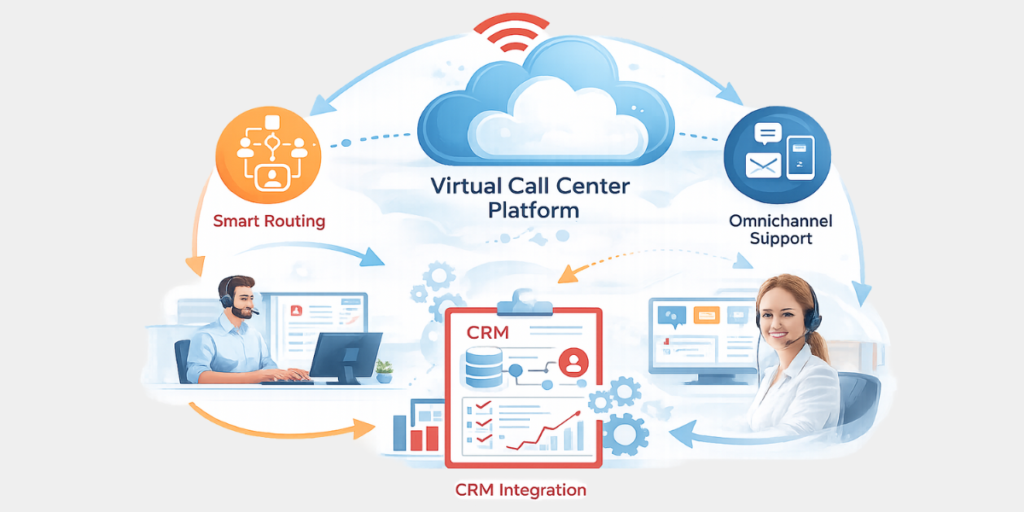
The entire setup runs on a powerful virtual call center platform, which is a key part of how to start a virtual call center the right way. It operates in the cloud to handle both incoming and outgoing interactions. Smart routing matches each customer to the best agent within milliseconds.
Contact Center Software is the engine that powers routing, agent tools, and reporting in one place. The platform is linked directly to CRM tools, and customer history appears when an agent answers. This assists agents in providing extra personal care and quicker solutions.
It also facilitates omnichannel service, therefore all the voice, email, SMS, and live chat are managed under a single roof.
- Cloud Infrastructure: It removes local PBX hardware.
- Smart Routing: Customers are matched with agents according to abilities.
- CRM Integration: Gives a 360-degree picture of the customer journey.
- Omnichannel Support: Links all online communications channels.
Helpful Resource: Contact Center Operations: Inbound, Outbound Voic,e Cha,t Email, and Telemarketing
Key Benefits For Modern Growth
The major advantages of modern growth are as follows:
- Reduced expenses and overheads.
- Increased productivity and satisfaction among the agents.
- 24/7 service across time zones in the world.
- Smarter coaching through AI and analytics.
- Improved work processes and quicker problem-solving.
- Higher customer loyalty
How To Setup A Virtual Call Center
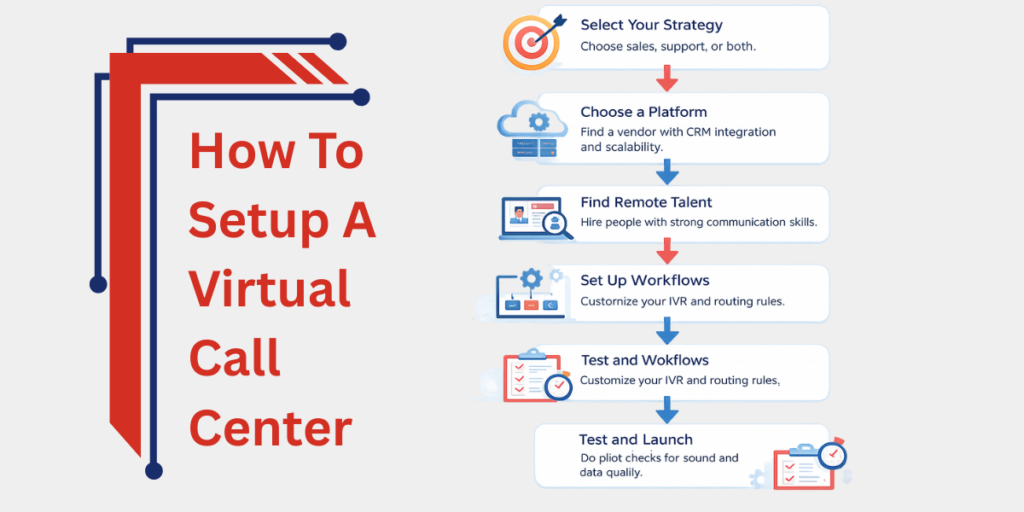
To know how to establish a virtual call center, a clear plan is required. Begin by specifying your business objectives. Determine whether you require inbound support or outbound sales. If revenue growth is the goal, an Outbound call center setup can focus on leads, follow-ups, and renewals.
The second step is to select the appropriate technology partner. Next, acquire trustworthy equipment for your remote team. Quality headsets andan internet that is reliable cannot be compromised.
If you need faster setup and fewer mistakes, Call Center Consultants can help design the workflow and rollout. Then configure your call flows. Create basic IVR call routing menus. This assists the customers in getting to the correct team.
- Select Your Strategy: Select sales, support, or a combination of the two.
- Choose a Platform: Find a vendor with integration and scalability of CRM.
- Find Remote Talent: Find a candidate who communicates well and has a very peaceful working environment.
- Set up Workflows: Customize your IVR and routing policies to achieve high efficiency.
- Test and Launch: Do Pilot checks to verify quality sound and data synchronisation.
KPIs And Metrics To Track
Performance tracking is necessary to make sure that your virtual call center is flourishing. Cloud-based operations are based on data.
Track Average Handle Time (AHT) to see how long agents spend on each case. This helps Contact Center Optimization by showing what needs fixing and what’s ready to scale.
Speed is not everything. First Call Resolution (FCR) is more important for satisfaction. It displays whether problems are solved the first time.
Monitor Customer Satisfaction (CSAT) to provide user feedback. Monitor the Call Abandonment Rate in order to identify staffing gaps. Real-time dashboards use Customer Experience Platforms.
Challenges And Future Trends
Challenges
- Maintaining corporate culture within a virtual team.
- Remaining engaged through video and chat software.
- Securing, encrypting, and complying with data (HIPAA/GDPR).
Future Trends
- Additional AI and automation of the daily support workflow.
- Predictive routing to match customers with the optimal agent.
- Man and robot collaborating to serve faster.
Helpful Resource: Effortless Cloud Contact Center Migration for Modern Enterprises
TLDR
A virtual contact center takes your customer support to the cloud. It reduces expenses and helps in hiring across the world. It has also employed AI to enhance the customer experience. A well-constructed plan of setups and appropriate KPIs will help you to expand quickly and provide 24/7 services.
Conclusion
The transition to a virtual contact center is no longer a choice. Staying competitive matters now. If you’re wondering how to set up a virtual call center, start by mapping out your tools, processes, and team setup.
The extent of scaling your brand is limitless. Customers receive quicker service and support. Remote management is not easy at first, but scalability and efficiency overcome it.
FAQs
What Is A Virtual Contact Center?
Customer support is configured as a cloud. There are agents who receive calls, chats, and emails online wherever they are.
What Is a Virtual Call Center Business?
A company that handles customer care and call centres under a single location. It can also deal with telemarketing and sales.
What Is a Virtual Call in a Virtual Call Center Platform?
An internet telephone call. It employs VoIP rather than conventional phone lines.
What Do You Mean By Virtual Business?
A primarily online-based company. It is based on digital tools and requires minimal or no physical office.
Are you willing to modernize your operations? Register for a free cloud evaluation with Skai Connect and visualize how our CCaaS and AI-driven support will help to multiply the growth.